Transitioning from AI PoC to Minimum Viable Product (MVP)


How to Successfully Develop an AI MVP After Your PoC
Transitioning from an AI Proof of Concept (PoC) to a Minimum Viable Product (MVP) is critical in AI product development.
The PoC stage is essential for demonstrating the feasibility of your AI solution, while the MVP stage focuses on delivering a functional product that customers can use.
Understanding how to scale from an AI PoC to an AI MVP ensures smooth and efficient development.
In this article, we will explore the key differences between PoC and MVP, strategies for scaling your AI PoC to an MVP, and the challenges that may arise along the way.
Understanding the AI MVP (Minimum Viable Product)
An AI MVP (Minimum Viable Product) is the first functional version of an AI solution that is deployable in real-world conditions.
Unlike a PoC, which validates an idea on a small scale, an MVP is designed for scalability, user interaction, and market testing.
An AI MVP aims to showcase the core features, solve specific problems, and provide a foundation for future iterations and improvements.
The AI MVP incorporates critical components like data processing, user interfaces, and integrations with existing systems while maintaining a streamlined feature set. It allows teams to test the market, gain valuable feedback, and iterate quickly based on user input.
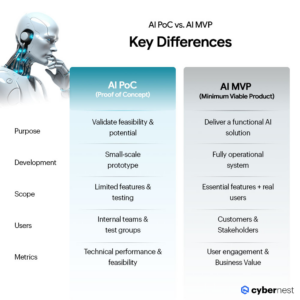
Key Differences Between PoC and MVP
While both PoC and MVP are essential stages in AI development, they serve distinct purposes and are fundamentally different:
1. Purpose:
PoC: A PoC is developed to validate the feasibility of an AI solution. It focuses on proving the technology can work in a specific use case.
MVP: An MVP is designed to deliver a functional product with essential features. It aims to meet users’ basic needs while collecting data for further refinement.
2. Scope:
PoC: The scope of a PoC is narrow, typically focusing on a single use case or feature that demonstrates the potential of the AI technology.
MVP: The MVP encompasses a broader scope, including key features that form the foundation of the product. It goes beyond mere validation and starts to address real-world challenges.
3. User Interaction:
PoC: The PoC is often an internal prototype used by the development team and stakeholders for validation. Customers may not directly use it.
MVP: The MVP is designed for external users, whether early adopters or pilot customers. It should be user-friendly and capable of generating real-world feedback.
4. Features:
PoC: A PoC may be a rudimentary solution with minimal functionality. It’s focused on showcasing proof of concept rather than providing a complete experience.
MVP: An MVP includes the core features necessary to provide value to customers. It’s not fully featured but contains enough to solve real user problems.
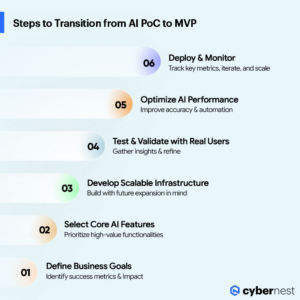
Strategies for Scaling Your AI PoC to MVP
Transitioning from a PoC to an MVP can be challenging, but with the right strategies, you can streamline the process and maximize the value of your AI product.
1. Refine Your AI Model
Your AI PoC may have demonstrated the feasibility of your solution, but for an MVP, you need a robust and scalable AI model. Begin by improving the model’s accuracy, reliability, and efficiency. Use a larger dataset to fine-tune the AI system and ensure it can handle real-world data and scale effectively.
2. Prioritize Core Features
An MVP should focus on the most valuable features that meet user needs. Review your PoC and identify which features are essential to provide real value. Ensure the core functionality is polished, while non-essential features can be added in future versions based on user feedback.
3. Establish a Scalable Architecture
As you move from PoC to MVP, your infrastructure should be capable of scaling with growing user demands. Ensure that your architecture is flexible, modular, and capable of handling increased traffic and data processing requirements. Cloud solutions and microservices architectures are often ideal for AI product scalability.
4. Focus on User Experience (UX)
An AI MVP needs to provide a seamless and intuitive user experience. Ensure the user interface (UI) is simple, accessible, and efficient. While the underlying AI model is crucial, the product’s usability will determine its success in the hands of real users.
5. Implement Data Security and Privacy Measures
AI products often handle sensitive data, making data security and privacy a critical component of the MVP. Implement robust security protocols, ensure compliance with relevant regulations (such as GDPR), and prioritize data collection and usage transparency.
6. Test with Early Adopters
Testing is an essential part of scaling your AI PoC to an MVP. Engage early adopters to test the product in real-world scenarios. Gather feedback on functionality, performance, and usability, and use this input to refine the product before broader release.
Challenges and Solutions in AI MVP Development
Scaling your AI PoC to an MVP comes with its own set of challenges. Let’s explore some common obstacles and strategies to overcome them:
1. Data Quality and Availability
Challenge: High-quality, sufficient data is essential for training and refining AI models, but acquiring this data can be difficult.
Solution: Leverage existing data sources, collaborate with industry partners, and explore synthetic data generation techniques to supplement real-world data.
2. Technical Debt
Challenge: Rapid development during the PoC phase may lead to technical debt, which can slow down the transition to a scalable MVP.
Solution: Regularly refactor code, improve the architecture, and invest in testing and documentation to minimize technical debt.
3. Scalability Issues
Challenge: Ensuring that the AI solution scales effectively to handle real-world users and large datasets can be complex.
Solution: Design a flexible and modular architecture from the beginning and use cloud services that offer easy scalability options.
4. Resource Constraints
Challenge: AI product development requires significant resources, including computational power, skilled talent, and time.
Solution: Prioritize features based on user needs and potential impact, and consider outsourcing or collaborating with AI development partners to fill skill gaps.
Conclusion:
Successfully transitioning from AI PoC to AI MVP requires a strategic, research-backed approach incorporating best practices in scaling, feature prioritization, and architecture design.
By understanding the key differences, applying effective scaling strategies, and addressing challenges head-on, businesses can create an AI MVP that is scalable, user-friendly, and ready to meet market demands.
The research also shows that AI companies that execute this transition enjoy faster time-to-market, better customer retention, and increased funding opportunities.